
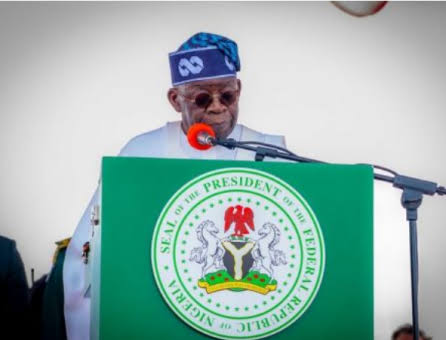
Democracy at 27: Celebrating Nigeria’s Longest Civilian Rule
- Nigeria has enjoyed 27 uninterrupted years of democratic governance since 1999.
- The President described it as the longest stretch of civilian rule in Nigeria’s history.
- He emphasized that leadership transitions, political disputes, and governance challenges are now largely resolved through elections, courts, and legislative institutions rather than violence.
- He called on Nigerians to defend and deepen democratic institutions.
Quote:
“Our democracy is not perfect, but it is ours.”
⸻
- Call for Credible Elections in Ekiti and Osun
- The President urged:
- INEC
- Security agencies
- Political parties
- Voters
to ensure peaceful and transparent elections in Ekiti and Osun States.
Key Message:
Democracy loses legitimacy when citizens lose confidence in the electoral process.
⸻
- Tribute to Heroes of Democracy and June 12
The President paid tribute to:
- Chief M.K.O. Abiola
- Alhaja Kudirat Abiola
- Chief Gani Fawehinmi
- Chief Bola Ige
- Chief Alfred Rewane
- Pa Abraham Adesanya
- Dr Beko Ransome-Kuti
- Frank Kokori
- Shehu Musa Yar’Adua
- Numerous activists, journalists, labour leaders and pro-democracy advocates.
Major Announcement
- The Institute of Petroleum Studies, Kaduna, will be renamed:
General Shehu Musa Yar’Adua University of Geological Sciences and Engineering Technology.
⸻
- Security Remains a Top Priority
The President acknowledged the national concern over the abduction of children in Oyo and Borno States.
Key Security Statistics
- More than 50,000 new police officers approved for recruitment.
- N5.41 trillion allocated to defence and security in the 2026 budget—the largest security allocation in Nigeria’s history.
- Terror-related deaths have fallen by 81% since 2015.
- Over 13,000 terrorists neutralised in the past year.
- 124,000 fighters and dependants surrendered through Operation Safe Corridor since 2023.
Military Success
- Nigerian forces reportedly degraded an ISWAP command centre in Arege, Borno State.
Key Message
“Surrender or face the full force of the Nigerian State.”
⸻
- National Unity Against Insecurity
The President warned against ethnicising crime.
Key Quote
“Crime has no ethnicity.”
He called for national unity in confronting terrorism, banditry, kidnapping and other security threats.
⸻
- Economic Reforms: Sacrifice Today, Prosperity Tomorrow
The President defended the economic reforms introduced since 2023.
According to him, the reforms have:
- Stabilised public finances.
- Improved fiscal transparency.
- Reduced leakages.
- Restored investor confidence.
Areas Attracting Increased Investment
- Agriculture
- Energy
- Manufacturing
- Technology
- Mining
- Transportation
- Creative industries
⸻
- Increased Revenue for States and Local Governments
A major argument made by the President is that reforms have significantly improved federation revenues.
Key Claims
- States and local governments now receive more allocations.
- More funds are available for:
- Infrastructure
- Healthcare
- Education
- Security
The President linked this directly to the administration’s economic policies.
⸻
- Push for Local Government Autonomy
The President described local government autonomy as a democratic imperative.
Key Argument
- Weak local governments contributed to:
- Poor service delivery
- Grassroots underdevelopment
- Insecurity
Focus
- Financial autonomy for all 774 local government councils.
⸻
- Electricity Sector Reform
The President painted a picture of a power sector plagued by:
- Generation shortfalls
- Weak transmission infrastructure
- Massive metering gaps
- Huge legacy debts
Key Statistics
- Over 4 million meter deficit inherited.
- Presidential Power Sector Task Force authorised to raise a N4 trillion bond to settle verified sector debts.
Major Achievements Claimed
- Signing of the Electricity Act.
- Decentralisation of electricity generation and distribution to states.
- Expansion of mini-grid and off-grid power solutions.
⸻
- Agriculture and Non-Oil Export Growth
Key Statistics
- 10,000 tractors to be deployed over five years through the National Agricultural Development Fund.
- Over 1,000 SMEs certified for export.
- Non-oil exports grew by 21% in the past year.
Key Message
- Diversifying Nigeria away from oil remains a strategic priority.
⸻
- Domestic Refining and Energy Security
The President highlighted increased domestic refining capacity.
Key Claim
- Reduced dependence on imported petroleum products.
- Improved energy security.
This is a reference to ongoing refining developments, including increased local refining output.
⸻
- Youth and Nation-Building
The President delivered a direct message to young Nigerians.
Key Quote
“Build here, code here, work here, and vote here.”
He encouraged youth participation in:
- Entrepreneurship
- Technology
- Civic engagement
- Nation-building
⸻
- Democracy Must Deliver Economic Freedom
One of the strongest themes of the speech was the shift from political freedom to economic freedom.
Key Message
- June 12 secured democracy.
- The current generation must secure prosperity.
Quote
“Democracy must be felt in the pocket.”
The President argued that democratic success should be measured through:
- Jobs
- Better incomes
- Opportunities
- Improved living standards
⸻
- National Honours for Democracy Activists
The President announced that dozens of pro-democracy activists, journalists, lawyers, military officers and civil society actors involved in the June 12 struggle will receive national honours.
The full honours list is expected to be released in the coming days.
⸻
Three Dominant Themes of the Speech
A. Defending Democracy
- 27 years of uninterrupted democratic rule.
- Electoral integrity.
- Honouring June 12 heroes.
B. Security and National Unity
- Massive security spending.
- Anti-terror successes.
- Rejection of ethnic narratives around crime.
C. Economic Reform and Shared Prosperity
- Economic stabilization.
- Power sector reforms.
- Local government autonomy.
- Job creation and investment.
- Moving from political freedom to economic freedom.
