
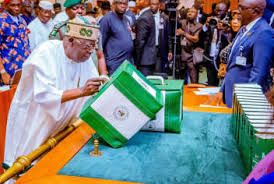
President Bola Ahmed Tinubu on Friday presented the 2026 Appropriation Bill to a joint session of the National Assembly, describing it as a “Budget of Consolidation, Renewed Resilience and Shared Prosperity” aimed at stabilising the economy and translating reforms into improved living standards for Nigerians.
Speaking at the National Assembly complex in Abuja, the President said the budget marked a defining moment in Nigeria’s reform journey, noting that his administration had, over the past two and a half years, tackled long-standing structural weaknesses, restored confidence and laid the groundwork for a more inclusive and resilient economy.
Tinubu acknowledged that the reform process had come with difficulties for households and businesses but assured Nigerians that the sacrifices were necessary and would yield lasting stability and shared prosperity. He said the 2026 budget was designed to consolidate gains, strengthen resilience and move the country from survival to sustainable growth.
According to the President, recent economic indicators show that reform efforts are yielding results. He said economic growth improved in the third quarter of 2025, inflation had moderated consistently for several months, oil production had increased due to better security and sector reforms, while non-oil revenues had expanded through improved tax administration. He added that investor confidence was returning and that Nigeria’s external reserves had risen to a multi-year high, providing a stronger buffer against external shocks.
Reviewing the implementation of the 2025 budget, Tinubu said execution was affected by transition challenges and competing demands, with revenue and expenditure performance below projections. He noted that emphasis was placed on completing outstanding capital projects from the previous fiscal year, while assuring lawmakers that 2026 would usher in stricter discipline in budget implementation. He said clear directives had been issued to ensure the budget is executed strictly in line with appropriations and timelines.
The President said improved revenue performance was expected from new tax laws and ongoing reforms in the oil and gas sector, stressing that the reforms were aimed not only at raising revenue but also at promoting transparency, efficiency and fairness. He added that government-owned enterprises would be held accountable for meeting revenue targets, supported by full digitisation of revenue collection to eliminate leakages and improve compliance.
Tinubu explained that the 2026 budget is guided by four main objectives: consolidating macroeconomic stability, improving the business and investment environment, promoting job-rich growth and poverty reduction, and strengthening human capital development while protecting vulnerable Nigerians. He said the government would spend with purpose, manage debt with discipline and pursue broad-based, sustainable growth.
Outlining the fiscal framework, the President said the budget was anchored on realism, prudence and growth, with projected revenues and expenditures reflecting national priorities and a commitment to fiscal sustainability and value-for-money spending. He added that projections were based on conservative assumptions for oil prices, production levels and exchange rates.
The President said significant allocations were made to defence and security, infrastructure, education and health, noting that the sectors are interconnected and critical to national renewal. He stressed that security remains the foundation of development, with increased support for modernising the armed forces, intelligence-driven policing, border security and community-based peacebuilding.
Tinubu also announced plans to reset the national security architecture, including the introduction of a new counterterrorism doctrine that treats armed groups operating outside state authority as terrorists. He said the government would show zero tolerance for terrorism, banditry, kidnapping and other violent crimes.
On human capital development, the President said the budget prioritised education, healthcare and social protection. He highlighted expanded access to higher education through the Nigerian Education Loan Fund and increased investment in healthcare, supported by partnerships with international donors.
In the area of infrastructure and economic productivity, Tinubu said the government would continue investing in transport, energy, agriculture and port modernisation to unlock private capital and boost growth. He said food security remains a national priority, with emphasis on mechanisation, irrigation, storage, processing and agro-value chains to reduce post-harvest losses and improve farmers’ incomes.
The President also pointed to ongoing procurement reforms, which he said had improved efficiency and generated cost savings, as well as the Nigeria First Policy designed to promote local content, support domestic industries and reduce dependence on imports.
Tinubu concluded by stressing that the true value of the budget lies in its delivery, pledging better revenue mobilisation, smarter spending and stronger accountability in 2026. He called on the National Assembly to partner with the Executive in charting Nigeria’s fiscal course, expressing confidence that the Renewed Hope Agenda would deliver a more secure, competitive and equitable nation.
He formally laid the 2026 Appropriation Bill before the National Assembly and urged lawmakers to give it prompt and favourable consideration.
