
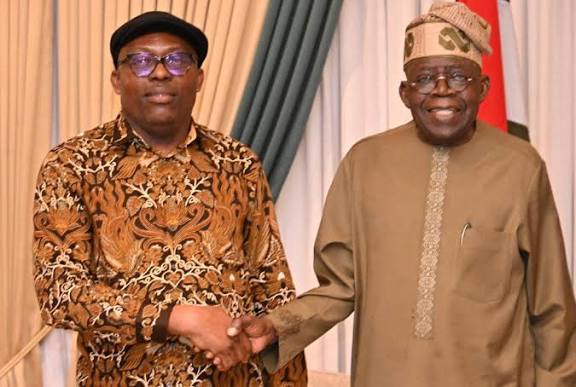
President Bola Ahmed Tinubu has commended Rivers State Governor, Siminalayi Fubara, for what he described as his responsible and effective leadership, particularly in handling sensitive issues relating to peace and development in Ogoniland.
Nigeria’s National Security Adviser (NSA), Mallam Nuhu Ribadu, conveyed the President’s message on Monday during a courtesy visit to Governor Fubara at the Government House in Port Harcourt. Ribadu led a high-level presidential delegation to the state as part of ongoing federal efforts to consolidate peace and accelerate development in Ogoniland after decades of unrest.
“Mr President asked me to thank you. He is very happy with you,” Ribadu told the governor, noting the President’s satisfaction with Fubara’s approach to discussions around the possible resumption of oil exploration in the area. He described Rivers State as one of the most peaceful in the country and said a “new chapter is unfolding in Ogoni,” marked by renewed hope and transformative initiatives. Ribadu also expressed appreciation to the Ogoni people for their patience and cooperation over the years.
The delegation included the Minister of Works, David Umahi; Minister of Environment, Balarabe Lawal; and senior officials of the Nigerian National Petroleum Company Limited (NNPCL).
During the visit, the federal government outlined several key projects and commitments aimed at boosting infrastructure, environmental restoration, and economic inclusion in the region.
These include the completion of the over N200 billion Eleme axis of the East-West Road, featuring five flyovers, expected by April 2026.
Other plans include the dualisation of the Bonny–Bodo Road with two flyovers and the proposed rerouting of the Lagos–Calabar Coastal Highway through Ogoniland. The delegation also highlighted progress on the Ogoni cleanup programme, in line with United Nations Environment Programme (UNEP) recommendations, covering mangrove restoration, healthcare delivery, and women empowerment initiatives.
In addition, NNPCL announced plans to employ 30 Ogoni indigenes, with appointments expected to take effect from January 2026, as part of efforts to deepen local participation and foster lasting peace in the area.
