
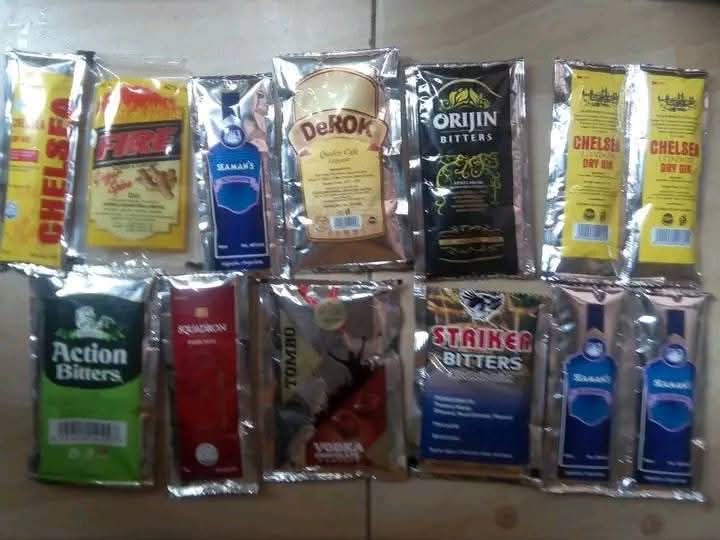
For more than two decades, a quiet but intense battle has brewed around one of Nigeria’s most ubiquitous products — sachet-packaged alcohol. Cheap, colourful and easy to conceal, these small plastic and sachets packs of strong spirits have found their way into motor parks, street corners, and increasingly, into the hands of underage children.
What began as a public health concern has now erupted into a full-blown faceoff involving regulators, labour unions, distillers and organised labour, with jobs, investments and the future of public health hanging in the balance.
At the centre of the storm is the National Agency for Food and Drug Administration and Control (NAFDAC), which has renewed its resolve to enforce a long-delayed ban on sachet alcohol and other alcoholic beverages packaged below 200 millilitres.
The move, NAFDAC insists, is driven purely by public health considerations — particularly the alarming rate of alcohol consumption among minors.
According to NAFDAC, the journey to ban sachet alcohol dates back to January 2004. However, sustained pressure from industry players and labour groups stalled implementation for years, stretching the policy battle into 2026.
Now, with fresh government backing, the agency says it is determined to see the policy through.
“The reality is painful,” NAFDAC Director-General, Prof. Mojisola Adeyeye, said during an interactive session with food sector stakeholders in Lagos. “You have alcoholic drinks sold for as low as N50, beautifully packaged, with as much as 30 per cent alcohol content — something a child can easily hide in a pocket and take to school.
Even I once mistook it for something else.”
Adeyeye lamented what she described as the normalisation of sachet alcohol consumption among motorcycle riders, artisans and, disturbingly, children as young as eight or nine years old.
“Whatever we are doing is to mitigate underage drinking,” she said. “We cannot continue breeding alcoholic children. We are destroying society from the inside out.”
Yet, NAFDAC’s stance has triggered fierce resistance from organised labour and industry unions, who argue that the ban threatens livelihoods, investments and indigenous businesses.
The Food, Beverage and Tobacco Senior Staff Association (FOBTOB) has emerged as one of the loudest voices opposing the policy.
At a press conference in 2025, FOBTOB warned that the proposed ban could wipe out nearly N2 trillion in investments and lead to massive job losses. Its National President, Comrade Jimoh Oyibo, said the beverage sector had invested heavily in machinery, raw materials and distribution networks tailored to sachet and small-pack products.
“Over 500,000 direct workers and about five million indirect workers across supply chains, logistics and distribution stand to be affected,” Oyibo cautioned. “This is not just about alcohol; it is about families, communities and survival.”
The union accused policymakers of relying solely on NAFDAC’s submissions while sidelining other critical stakeholders. Oyibo argued that Nigeria already has a validated National Alcohol Policy, which recommends stricter enforcement, licensing of liquor outlets, public enlightenment campaigns and multi-sectoral collaboration — not an outright ban.
FOBTOB also disputed claims that sachet alcohol is widely abused by minors, insisting that independent, government-backed studies had debunked such assertions. According to the union, industry players have spent over one billion naira on campaigns promoting responsible drinking and discouraging underage consumption.
“As the saying goes, it takes the mother chicken to live to raise its young ones,” Oyibo said, urging the government to protect businesses that contribute significantly to the economy rather than cripple them through sudden policy shifts.
The controversy has since drawn in the Nigeria Labour Congress (NLC), the Nigeria Employers’ Consultative Association (NECA) and other workers’ groups, all of whom have staged protests against the ban. Critics of the resistance, however, argue that economic self-interest is being placed above the wellbeing of Nigerian children.
Public health experts have consistently warned that sachet alcohol poses unique risks. Its low price and high accessibility encourage early and frequent consumption, particularly among youths and low-income groups.
Alcohol use is linked globally to more than 200 health conditions, including liver disease, cardiovascular problems, certain cancers and mental health disorders. Easy access also increases the risk of addiction, road accidents, violence and family breakdown.
These concerns, authorities say, informed Nigeria’s decision to prohibit the production and sale of sachet alcohol and very small packaged drinks in the first place.
As the debate rages on, Nigeria finds itself at a crossroads: balancing the protection of public health — especially that of vulnerable children — against the economic realities of jobs, investments and industrial survival.
Whether compromise or confrontation will ultimately define the outcome remains to be seen, but one thing is clear — the sachet alcohol saga is no longer just about drinks in plastic packs; it is about the kind of society Nigeria wants to build.
